
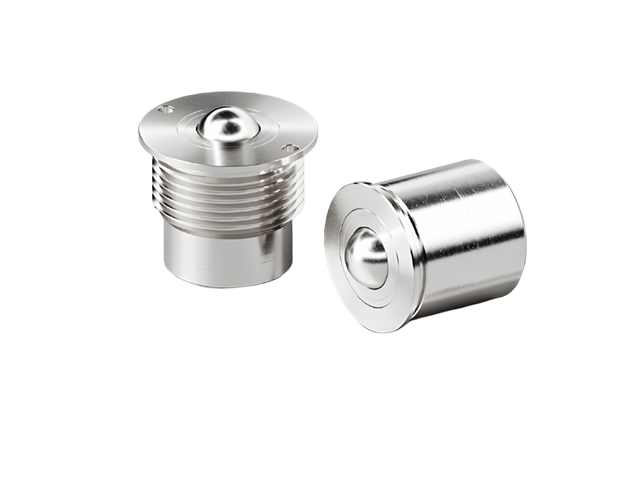
BCHP Ball Transfer Unit | Spring-Loaded Plunger Press-Fit | 304 Stainless Steel | JDF
The BCHP Series Ball Transfer Unit is a spring-loaded plunger type omnidirectional load-bearing unit with a 440C stainless steel main ball and 304 stainless steel body. The main ball is supported by an internal spring that allows the ball to retract under load and return to its original position when the load is removed. This plunger mechanism provides shock absorption and helps with workpiece positioning on conveyor tables, assembly lines, and material handling systems. The press-fit design requires a precision-drilled hole with H7 tolerance, providing a flush surface after installation.
How to select the right BCHP unit:
Determine the weight of the heaviest item to be moved.
Estimate the minimum number of units that will bear the load at any moment (typically 3-4 for flat loads).
Divide the total load by the minimum supporting units to get the nominal load per unit.
Apply a safety factor: divide the rated capacity by 2 for steady handling, or by 3 for shock/impact or continuous duty.
Calculate the maximum spacing between units: divide the shortest edge of the load by 2.5.
Select the model whose rated capacity exceeds the required per-unit load after applying the safety factor.
Example: For a 30 kg load supported by 4 units, the nominal load per unit is 7.5 kg. With a safety factor of 2, the required rated capacity is 15 kg (approx. 147 N). BCHP14 (23N) or BCHP18 (24N) may be suitable depending on the actual number of supporting units and the required plunger travel.
Installation Notes:
Press-fit type: recommended mounting hole tolerance is H7. The hole should be drilled straight through, with both ends lightly chamfered to remove burrs.
Do not strike the main ball directly during installation. Apply force only to the housing flange edge.
For batch installation, a positioning template is recommended to ensure hole alignment.
The plunger mechanism allows the ball to retract under load. Ensure sufficient clearance below the mounting surface for the retraction travel.
Working temperature range: -20°C to +70°C. Max speed: 1 m/s for steel ball types.
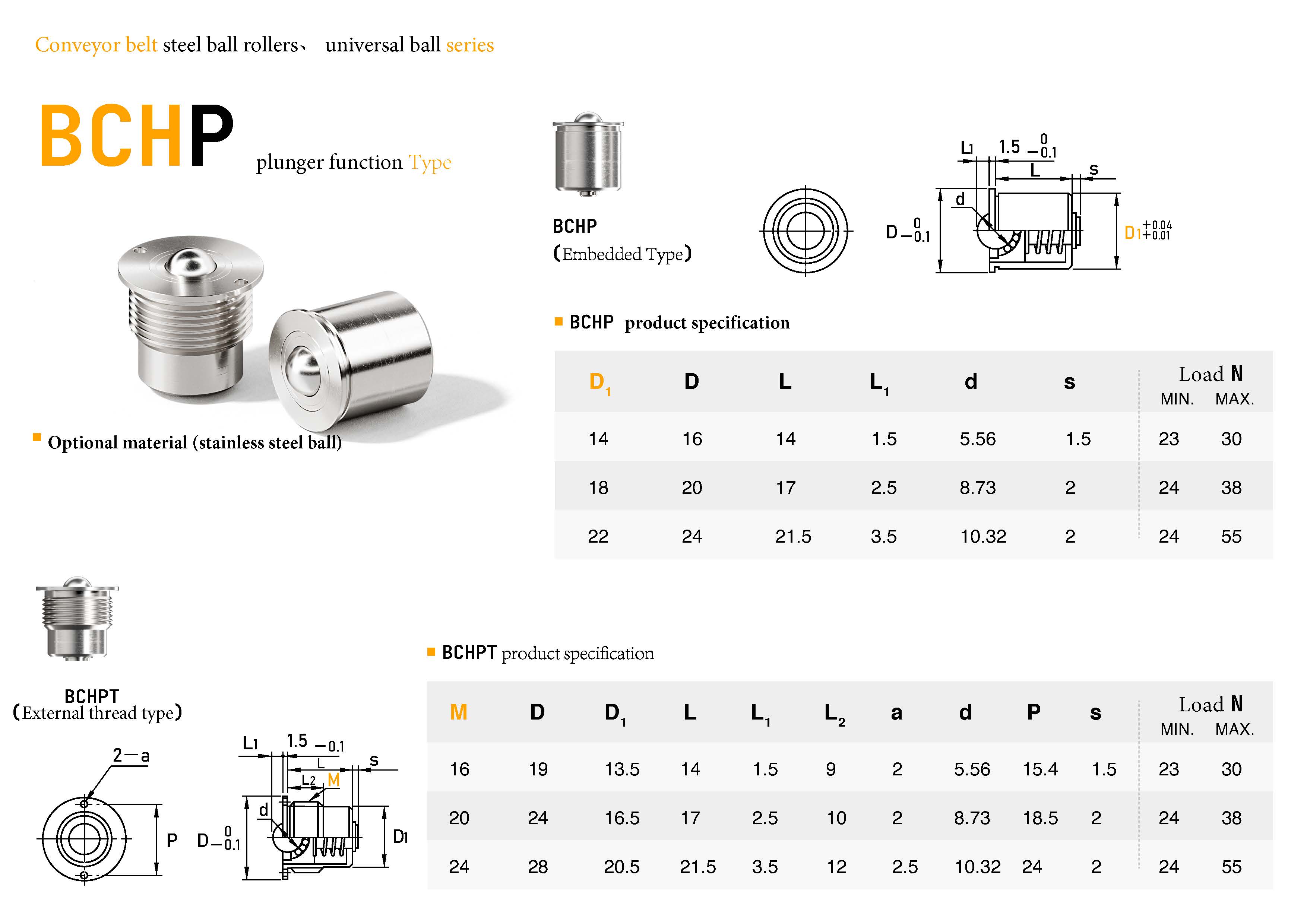
Technical Specifications Table
| Model | O.D. D (mm) | L (mm) | H (mm) | d (mm) | Mounting Hole D1 (mm) | Allowable Load N (kgf) |
|---|---|---|---|---|---|---|
| BCHP14 | 14 | 16 | 14 | 5.56 | 14 | 23 (2.3) |
| BCHP18 | 18 | 20 | 17 | 8.73 | 18 | 24 (2.4) |
| BCHP22 | 22 | 24 | 21.5 | 10.32 | 22 | 55 (5.6) |
Typical Applications
The BCHP Series Ball Transfer Unit is widely used in the following applications:
Assembly Lines & Workstations: Shock absorption and precise positioning of workpieces, with the plunger mechanism providing cushioning when loads are applied
Conveyor Transfer Points: Direction changes at conveyor curves or intersections, with impact absorption
Packaging & Inspection Stations: Free movement of workpieces on packaging or inspection tables, with plunger function aiding workpiece positioning
Precision Equipment Feed Mechanisms: Flexible contact and positioning of workpieces utilizing the spring cushioning characteristics
Logistics & Warehousing Equipment: Low-friction movement of light loads on transfer tables or storage racks
FAQ
Q1: What is the difference between BCHP and BCHA?
A: BCHP uses a spring-loaded plunger mechanism where the main ball can retract under load, making it suitable for shock absorption and workpiece positioning. BCHA uses a standard fixed ball for general load bearing and transfer. Choose BCHP when cushioning is required; choose BCHA for standard transfer applications.
Q2: What models are available in the BCHP series?
A: The BCHP series includes three standard models: BCHP14, BCHP18, and BCHP22. The model number corresponds to the outer diameter, ranging from 14mm to 22mm. Ball diameter and load capacity increase with model size, from 23N (BCHP14) to 55N (BCHP22).
Q3: What is the difference between BCHP and BCHPT?
A: BCHP is press-fit type, requiring a press to install into an H7 tolerance hole. BCHPT is threaded type, secured by M16x1.5, M20x1.5, or M24x1.5 threads and tightened with a dedicated wrench (BCHPT-BR). Both share the same plunger cushioning function and load capacity — the only difference is the mounting method.
Q4: Can BCHP units be used in wet or corrosive environments?
A: Yes. The 304 stainless steel body and 440C stainless steel main ball provide good corrosion resistance, making BCHP units suitable for food processing, pharmaceutical, and outdoor applications.
Q5: How do I install a BCHP unit?
A: BCHP units are press-fit type. The recommended mounting hole tolerance is H7. The hole should be drilled straight through, with both ends lightly chamfered to remove burrs. Do not strike the main ball directly — apply force only to the housing edge. Ensure sufficient clearance below the mounting surface for the plunger retraction travel.