
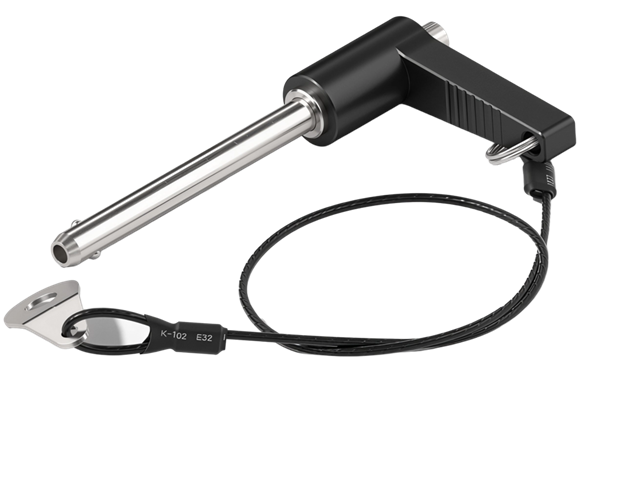
L-Handle Quick Release Ball Lock Pin | 17-4PH Stainless Steel | MS17986 Standard | JDF
The L-Handle Quick Release Ball Lock Pin is a positive-locking, quick-release alignment pin with a precision-ground shank and an L-shaped handle. The L-handle design features a right-angle asymmetrical structure that fits flush with mounting surfaces, preventing accidental rotation during equipment operation. This makes it ideal for compact fixtures, corner positions, and structural wall adjacency installations where a T-handle would be obstructed. The spring-loaded balls engage close-fitting holes to lock the pin securely in place, and will not release until the button on the handle is depressed. Available in single-acting and double-acting configurations, with pin diameters from 3/16" to 1" (5mm to 20mm in metric).
How to select the right L-Handle Ball Lock Pin:
Determine the pin diameter: Match the pin diameter to the mounting hole. Recommended hole tolerance is H11. The pin should slide in easily while maintaining a snug fit to prevent play.
Measure the grip length: The grip length is the distance from the bottom of the handle collar to the top of the locking ball. It must match the total thickness of the plates being joined. Standard grip lengths range from 0.50" to 3.00" (12.7mm to 76.2mm), with special lengths available up to 12" (300mm).
Calculate the load: Determine the shear load the pin will experience. Apply a safety factor of 2 for static loading, or 3 for dynamic/impact loading. The required shear strength = actual load × safety factor.
Select the material: Choose 300 series stainless steel for general applications, or 17-4PH stainless steel for higher shear strength and demanding environments.
Choose single-acting or double-acting: Single-acting releases with a button press; double-acting requires button press + rotation for added security against accidental release.
Example: For a 500 kg static load in double shear, with a safety factor of 2, the required shear strength is 1000 kg (approx. 2200 lbf). A 3/8" diameter 17-4PH pin (double shear strength approx. 10,000+ lbf for 300 series, higher for 17-4PH) is more than sufficient. A 1/4" pin may also be considered depending on the actual number of pins and load distribution.
Installation and Operation:
Insert the pin into the mounting hole with the button depressed. The spring-loaded balls will retract, allowing the pin to slide through.
Release the button. The balls will spring out and engage the groove or hole on the far side, locking the pin in place.
The L-handle design allows the handle to rest flush against the mounting surface, reducing the risk of accidental snagging or rotation during equipment operation.
To remove, press the button (single-acting) or press and rotate (double-acting). The balls retract and the pin can be pulled out.
The L-handle can also be used with a lanyard to prevent loss.
Technical Specifications Table
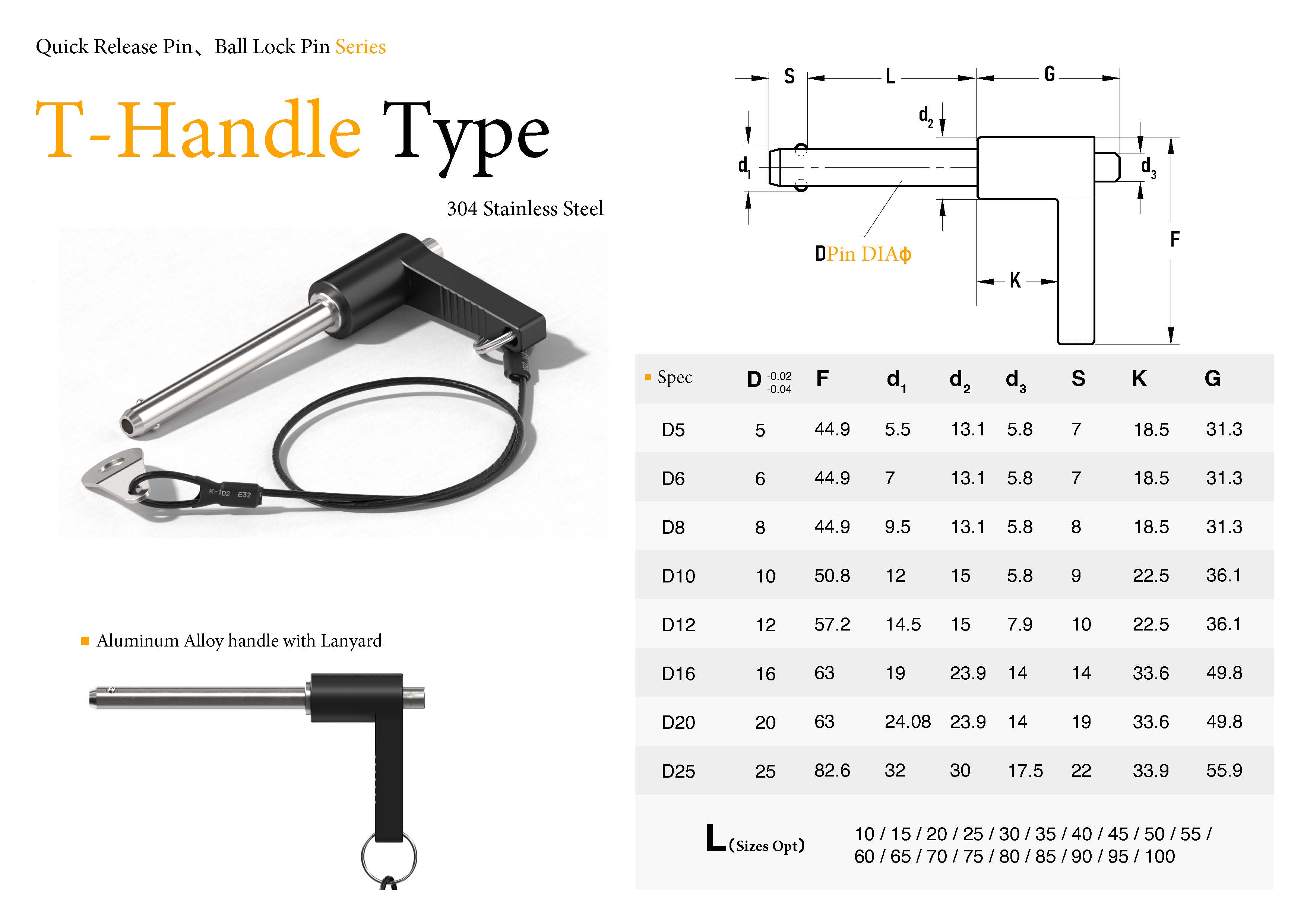
| Model | Pin Diameter (in/mm) | Grip Length (in/mm) | Shank Material | Ball Material | Action | Double Shear Strength (lbf/kN) |
|---|---|---|---|---|---|---|
| JDF-LH-3/16 | 3/16" (4.8mm) | 0.50"-3.00" | 300 SS | 440C | Single Acting | 2,500 / 11.1 |
| JDF-LH-1/4 | 1/4" (6.4mm) | 0.50"-3.00" | 300 SS | 440C | Single Acting | 4,500 / 20.0 |
| JDF-LH-5/16 | 5/16" (7.9mm) | 0.50"-3.00" | 17-4PH | 440C | Single Acting | 7,250 / 32.2 |
| JDF-LH-3/8 | 3/8" (9.5mm) | 0.50"-3.00" | 17-4PH | 440C | Single/Double | 10,000 / 44.5 |
| JDF-LH-1/2 | 1/2" (12.7mm) | 0.50"-3.00" | 17-4PH | 440C | Single/Double | 19,250 / 85.6 |
| JDF-LH-5/8 | 5/8" (15.9mm) | 0.50"-3.00" | 17-4PH | 440C | Double Acting | 30,000 / 133.4 |
Typical Applications
The L-Handle Quick Release Ball Lock Pin is widely used in the following applications:
Aerospace & Aviation: Quick release of aircraft access panels, conforming to MS17986/NAS1333-1343 standards, with L-handle design for operation in tight spaces
Fixtures & Positioning: Quick locating and locking of workpieces on fixtures, with L-handle resting flush against mounting surface to prevent accidental rotation
Compact Structures & Corner Installations: Ideal for space-constrained fixtures, corner positions, and structural wall adjacency installations, solving clearance conflicts in dense mechanical assemblies
Mold & Die Changing: Fast locking and release of molds during changeover, improving efficiency
Industrial Equipment Maintenance: Quick fastening of frequently removed panels, covers, and guards
Automotive & Marine: Quick adjustment and removal in automotive suspension systems, aircraft landing gears, and marine equipment
FAQ
Q1: What is the difference between an L-handle and a D-ring handle?
A: The L-handle features a right-angle asymmetrical structure that fits flush with the mounting surface, making it ideal for compact fixtures, corner positions, and structural wall adjacency installations, preventing accidental rotation during equipment operation. The D-ring handle is designed for fingers to pass through for operation, but occupies more space and is better suited for applications with sufficient space and lanyard connection needs.
Q2: What is the difference between an L-handle and a T-handle?
A: The T-handle provides maximum pulling leverage for heavy-duty equipment and gloved-hand operation, but occupies significant lateral space. The L-handle balances leverage and space occupation, offering reliable pulling force without the large footprint of a T-handle, making it ideal for compact structures and space-constrained scenarios.
Q3: What is the difference between single-acting and double-acting ball lock pins?
A: Single-acting pins release with a simple button press, offering quick and convenient operation. Double-acting pins require both button press and rotation to release, providing higher security against accidental release, suitable for applications with vibration or where accidental operation must be prevented.
Q4: What is the difference between 300 series stainless steel and 17-4PH stainless steel?
A: 300 series stainless steel is austenitic, with good corrosion resistance, suitable for general load and corrosive environments. 17-4PH is a precipitation-hardening stainless steel that achieves HRC40+ hardness after heat treatment, offering higher shear strength and excellent corrosion resistance for high-load applications.
Q5: How do I calculate the load capacity of a ball lock pin?
A: Ball lock pin load capacity is measured by double shear strength and pull-out strength. Double shear strength is the fracture load of the pin under two shear planes. Pull-out strength is the force required to dislodge the ball from the hole. Select with a safety factor of 2 for static loads, or 3 for dynamic/impact loads.