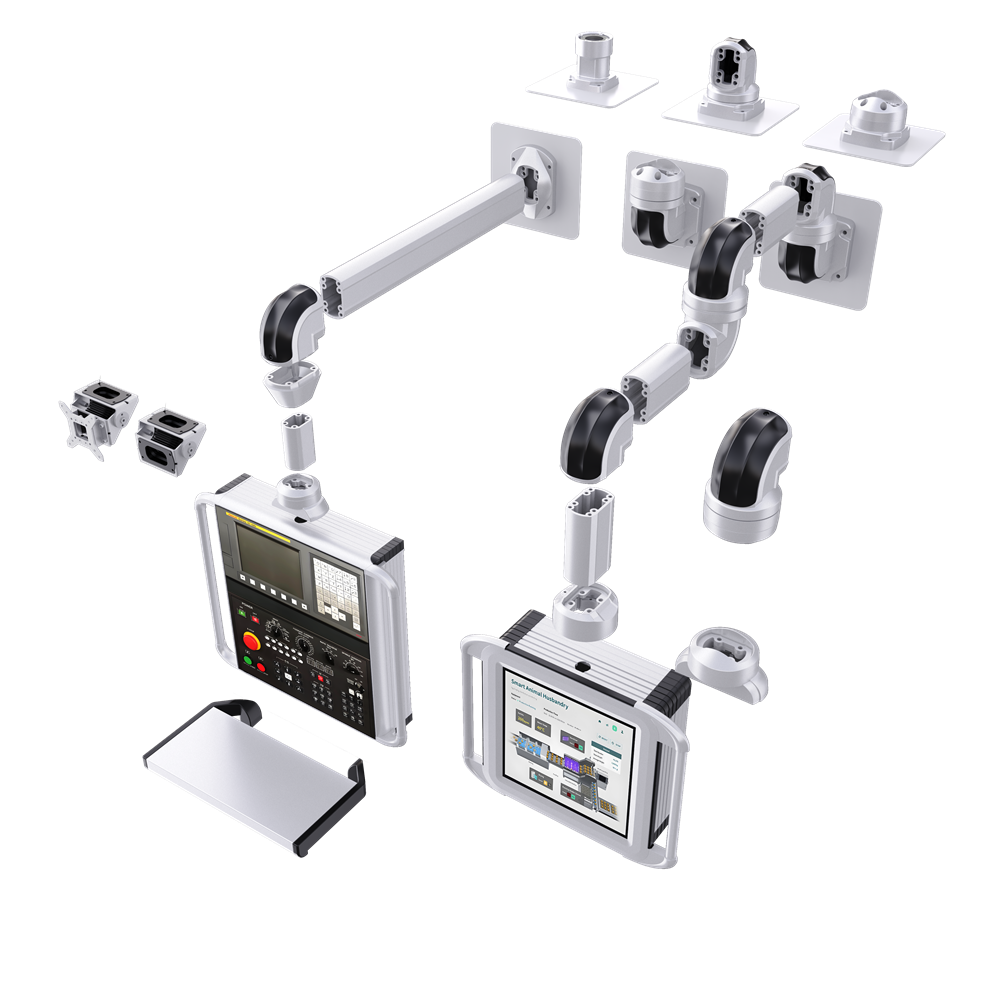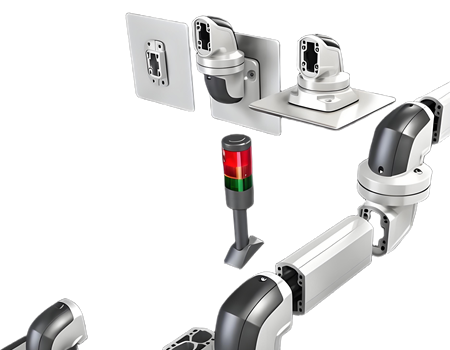
When designing a control station or mounting an HMI (Human-Machine Interface) panel on the factory floor, engineers often prioritize reach and ergonomics. You want the screen to be right in front of the operator. However, extending the reach of a support arm system comes with a critical engineering trade-off: increased reach equals decreased load capacity.
If you are sourcing support arm systems, understanding the physics behind this principle is essential to prevent structural failure, sagging, and safety hazards. Here is why longer arms carry less weight and how to specify the right system for your application.
The Physics: Torque and Bending Moment
The primary reason longer arms carry less weight is due to the laws of physics—specifically, torque and the bending moment.
Imagine a support arm as a lever. The weight of your control box or monitor acts as a downward force at the end of the lever. The connection point (the base or the wall joint) acts as the pivot.
Torque (T) = Force (F) × Distance (D)
As the arm length (Distance) increases, the torque (bending moment) applied to the joints and the base increases exponentially, even if the weight of the control box (Force) remains the same.
In simple terms: A 20 kg control box mounted on a 500 mm arm exerts a certain stress on the joints. If you change that arm to 1000 mm, the stress on the base joint and the arm itself doubles. Therefore, to maintain structural integrity and smooth movement, the load capacity must be reduced as the arm gets longer.
The 3 Key Limiting Factors of a Long Arm System
When an arm is extended, it is not just the weight of your equipment that the system must handle. You must also account for the internal stresses on the components:
Joint Friction and Braking Strength: The joints (or friction hinges) must hold the panel in place. A longer arm creates a stronger lever effect, meaning standard joints will simply slip or sag under the weight.
Material Deflection (Sagging): Even high-strength aluminum (like 6063-T5) has a flex point. Longer arms are prone to bending over time if overloaded, which degrades the operator's experience.
Base Plate Anchoring: The wall or machine base where the arm is mounted must withstand the pull-out force. A longer arm creates a massive leverage effect, potentially pulling anchors out of sheet metal or concrete.
How to Calculate Your Needs (The Load Capacity Curve)
At JDF-FA, we provide specific Load Capacity Curves (Load vs. Distance) for every support arm system.
Rule of Thumb: If you double the length of the arm, you generally have to cut the maximum allowable load in half.
Example: A standard single-joint arm with a 300mm profile might support 30 kg. If you add a 500mm extension tube to the same system, the maximum recommended load might drop to 15 kg to ensure the joints don't slip and the tube doesn't bend.
Engineering Solutions: How to Extend Reach Safely
If your application requires a longer reach but your control box is heavy, do not compromise on safety. Consider these engineering solutions:
Heavy-Duty Joints: Upgrading to reinforced, high-friction joints (like our [linked to Heavy Duty Joint page]) to handle the increased torque.
Larger Profile Tubes: Using thicker or larger cross-section aluminum tubes (e.g., 60x60mm instead of 40x40mm) to increase stiffness and resist bending.
Dual-Arm or Articulated Configurations: Instead of one long arm, use two shorter arms connected by a central joint. This distributes the weight and provides better flexibility without over-stressing a single pivot point.
Vertical Support Brackets: For extremely long horizontal reaches, adding a support strut or a ceiling-mounted bracket helps take the load off the wall joint.
Conclusion
Choosing the right support arm system isn't just about matching the mounting hole pattern; it's about understanding the dynamic relationship between weight, reach, and torque. Ignoring load capacities can result in equipment damage or operator injury.
Need help calculating your load capacity? Our engineering team at [你的公司名] is here to help. [Contact us today] for a custom sizing consultation or download our [Support Arm System Catalog] to view our complete load capacity charts.